15th International BRRP Symposium
Department for the Study of Ancient and Medieval Thought, Institute...
Read More
Philomitte is an online resource dedicated to the philosophical traditions of Central Europe in the Middle Ages. The name plays on the German Mitte (“centre”), evoking both “Mitteleuropa” and the “Mittelalter” (Middle Ages).
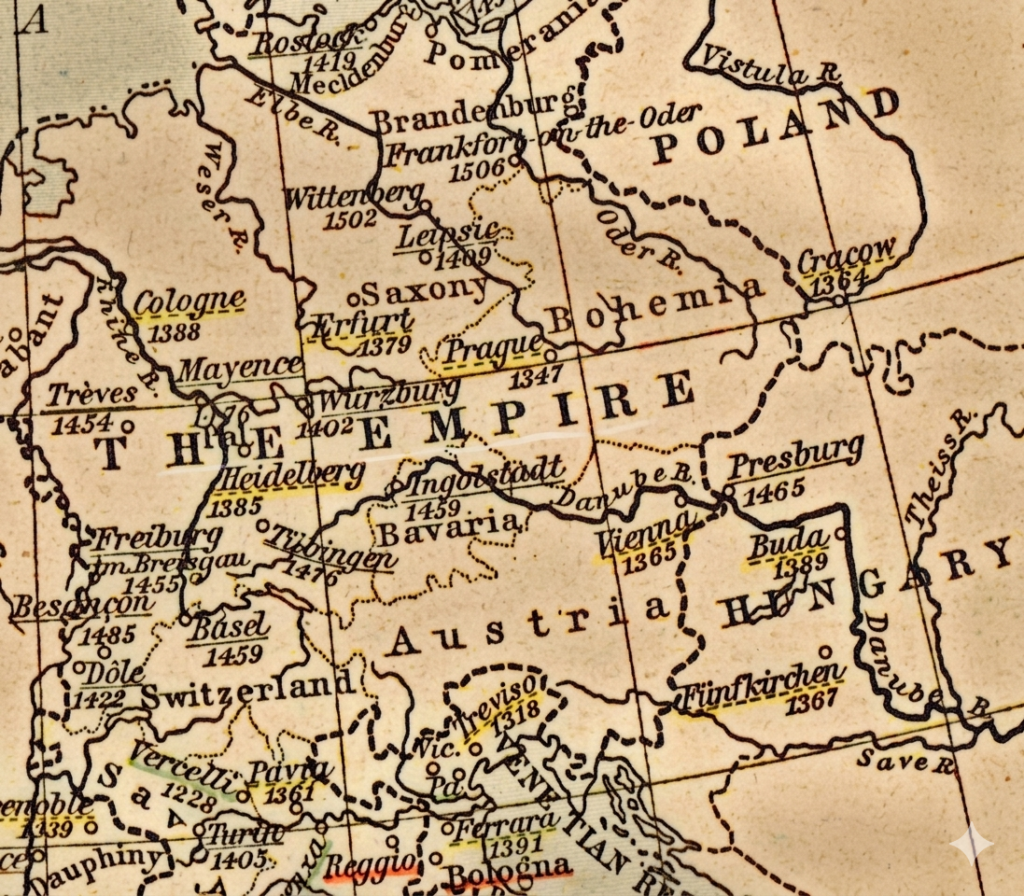
“Central” is understood here primarily as a geographical category encompassing the broad region stretching from the Rhine to the Vistula, within which distinctive cultural and intellectual traditions historically flourished. The choice of the German term is not intended to revive the political projects with which Mitteleuropa was at times associated in the past. Rather, it acknowledges the deep intellectual connections that linked the German lands with Bohemia, Poland, and Hungary, forming a shared historical space that remains at the heart of Europe today.
Although no medieval concept of “Central Europe” existed, the region’s intellectual history found a clear focal point in 1348 with the foundation of the University of Prague. The first university north of the Alps and east of Paris, it became a major centre of philosophical and theological learning whose influence extended throughout the network of universities founded during the fourteenth and fifteenth centuries—not only Leipzig, Vienna, and Kraków, but also Heidelberg and Cologne. This portal is devoted to the study of the intellectual traditions that emerged within this central European milieu and fostered a remarkable period of cultural and scholarly flourishing.
Philomitte reflects Andrea Fiamma’s research themes on the history of medieval philosophy in Central Europe, which follow, in an ideal sense, the itinerary of Nicholas of Cusa‘s journey between December 1450 and April 1452. Nicholas travelled from Rome through Salzburg, Vienna, Mainz, Cologne, up to the Low Countries, spreading his philosophical ideas in centres such as Erfurt, Hildesheim, and Wilsnack. He finally reached Brixen, the seat of his bishopric. Among the many legacies of this expedition was the creation, by his collaborators, of one of the earliest cartographic representations of Central Europe.
While Nicholas of Cusa’s travels brought him into contact with parishes, monasteries, and ecclesiastical institutions, they did not extend to the universities – Philomitte ideally complements his journey by tracing a parallel itinerary through the intellectual life of the universities of Central Europe, such as Cologne (from the Dominican Studium to the University Albertism), Heidelberg (John Wenck, Marcellus Geist and other Masters), the Faculties of Arts, Law and Theology at Vienna, and at Prague, Leipzig, and Krakow through the PRAISE Project.
Department for the Study of Ancient and Medieval Thought, Institute...
Read More